
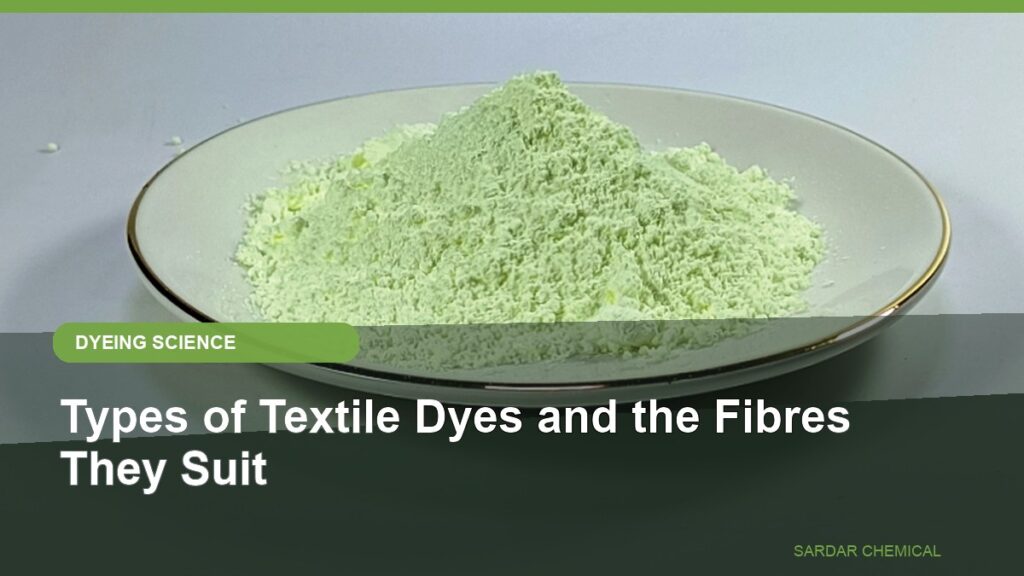
Textile dyes are selected first by the material and the required performance. Acid, direct and reactive dyes are not interchangeable categories: each has a different relationship with the fibre and different processing considerations. Start with the fibre composition, including blends, before choosing a commercial grade.
Textile dye classes and selection starting points
| Dye class | Typical selection context | What to confirm |
|---|---|---|
| Reactive dyes | Cotton and other cellulosic dyeing applications | Exact grade, application route, fixation and wash-off guidance, and required fastness |
| Direct dyes | Cellulosic applications where a direct-dye route meets the end-use brief | Shade, wet performance, staining, and any proposed after-treatment |
| Acid dyes | Protein fibres and polyamide applications, subject to grade suitability | Fibre compatibility, levelness, process conditions and end-use testing |
This is a starting map, not a statement that every grade in a dye class suits every material. For blends or specialist fibres, obtain a process-specific recommendation.
Reactive dyes for a defined cotton process
Reactive dyes can form chemical bonds with cellulosic fibres under suitable conditions. Selection still depends on the exact grade, equipment, shade and application route. Ask for grade-specific processing information and assess the complete outcome, including washing and finishing.
Direct dyes and end-use performance
Direct dyes offer a different selection route for cellulosic materials. Assess whether the resulting shade and performance satisfy the buyer’s requirements. Where after-treatment is proposed, evaluate its effects as part of the full process rather than treating it as a universal answer.
Use distinct product checks for individual grades, such as Direct Black 19 and Direct Red 80.
Acid dyes and substrate compatibility
Acid dyes are relevant to protein-fibre and polyamide selection, but the commercial grade and recommended use must be confirmed. Leather dyeing introduces its own material and processing considerations; it should not be treated as identical to textile dyeing simply because a dye class is shared.
Optical brighteners are not a substitute for coloured dyes
Optical brighteners use fluorescence to affect perceived whiteness and brightness. Select for the material, desired tone, compatibility and viewing conditions. Product names such as Leucophor require exact grade confirmation; a familiar name alone does not establish identity or equivalence.
What to send a textile dye manufacturer or supplier
- Fibre composition, substrate preparation and the intended end use.
- A physical shade reference and agreed assessment conditions.
- Application method, equipment and relevant process constraints.
- Required fastness, staining and other customer test methods.
- Estimated quantity and sample or quotation requirements.
- Restricted-substance specifications and destination documentation needs.
Ask for current technical and safety data for the exact product. If azo-free dyes are specified, use a product-specific documentation review rather than relying on a general label.
Approve a system, not only a powder sample
Assess representative material through preparation, dyeing, washing and finishing. Keep records of the commercial product, batch and relevant operating conditions. Evaluate both the shade and the end-use tests, then retain an accepted sample for repeat orders. There is no single best textile dye without a defined material and performance brief.
Send your textile dye selection enquiry or browse the product families.
Related Articles
Right-First-Time Dyeing: Reducing Rework and Variation
Learn about right first time dyeing, key selection factors, quality checks and practical sourcing guidance from Sardar Chemical Industries.
Read More
Dye Recipe Reproducibility: Records That Matter
Learn about dye recipe reproducibility, key selection factors, quality checks and practical sourcing guidance from Sardar Chemical Industries.
Read More
Delta E in Textile Colour Matching: Buyer’s Overview
Learn about Delta E textile colour, key selection factors, quality checks and practical sourcing guidance from Sardar Chemical Industries.
Read More