
Acids and bases are central ideas in chemistry. They help explain common reactions, lab data, body chemistry, and many AP Chemistry problems. Once you see how acidic solutions, weak bases, strong acids, acid-base indicators, buffer solutions, and neutralization reactions fit together, acid-base chemistry is easier to predict than to memorize. This guide moves from the basic acid and base definition to pH, equilibrium, labs, and AP-level work.
What are acids and bases?
A useful acid and base definition starts with how substances behave in water and during proton transfer. In simple terms, acids raise hydrogen ion activity in solution, while bases lower it or produce hydroxide ions, depending on the model. More advanced definitions focus on proton donation and acceptance. That helps explain reactions that do not fit a water-only view.
In intro chemistry, acids are often described as sour, able to react with some metals, and able to turn blue litmus paper red. Bases are often described as slippery, bitter, and able to turn red litmus paper blue. Tasting or touching chemicals is not safe lab practice, so these basic properties are only clues. Chemists rely on models, data, and equations instead.
Common acid base examples include hydrochloric acid in the lab, acetic acid in vinegar, citric acid in citrus fruit, ammonia as a weak base, and sodium hydroxide as a strong base. These examples show that acids and bases are not limited to beakers and test tubes. They also appear in cleaning products, food chemistry, environmental systems, medicine, and industry.
The main models of acid-base behavior
Different models explain acids and bases at different levels of detail. The Arrhenius model is often taught first because it is easy to apply to aqueous solutions. In this model, an acid makes hydrogen ions in water, while a base makes hydroxide ions in water.
The Brønsted-Lowry model is more flexible. It defines an acid as a proton donor and a base as a proton acceptor. In this framework, the Brønsted-Lowry model includes conjugate acids and bases. When an acid gives up a proton, it becomes its conjugate base. When a base gains a proton, it becomes its conjugate acid.
This idea helps explain why acid-base reactions often go in two directions. A molecule may act as an acid in one reaction and a base in another, depending on the substance it reacts with. Water is a classic example. It can take a proton to make hydronium or give a proton to make hydroxide.
Strong acids and weak bases behave differently
Strong acids split into ions almost fully in water. Hydrochloric acid, nitric acid, and sulfuric acid are common examples students learn early because they split into ions almost fully in many class problems. That makes strong acid calculations more direct, especially when concentration is known.
Weak bases, by contrast, react only partly with water. Ammonia is a common example because it takes a proton from water to form ammonium and hydroxide, but the reaction does not go to completion. That partial reaction creates chemical equilibrium, so students must think about both the forward and reverse steps.
Strong and weak do not mean safe and unsafe. They describe how much the acid or base reacts in solution. A concentrated weak acid or weak base can still be hazardous, while a dilute strong acid may be easier to handle with proper lab care.
Why pH balance matters
The pH scale shows how acidic or basic a solution is, and pH balance matters because many chemical and biological systems work only in a narrow range. A small pH change can affect reaction rates, how well substances dissolve, enzyme activity, and the form of dissolved substances. Because the pH scale is logarithmic, each whole-number step means a tenfold change in hydrogen ion activity.
A solution below 7 is acidic, a solution above 7 is basic, and a solution near 7 is neutral under normal class conditions. Pure water is often the neutral reference, but real samples can contain dissolved gases, salts, or impurities that shift pH. That is why careful pH measurement matters in labs.
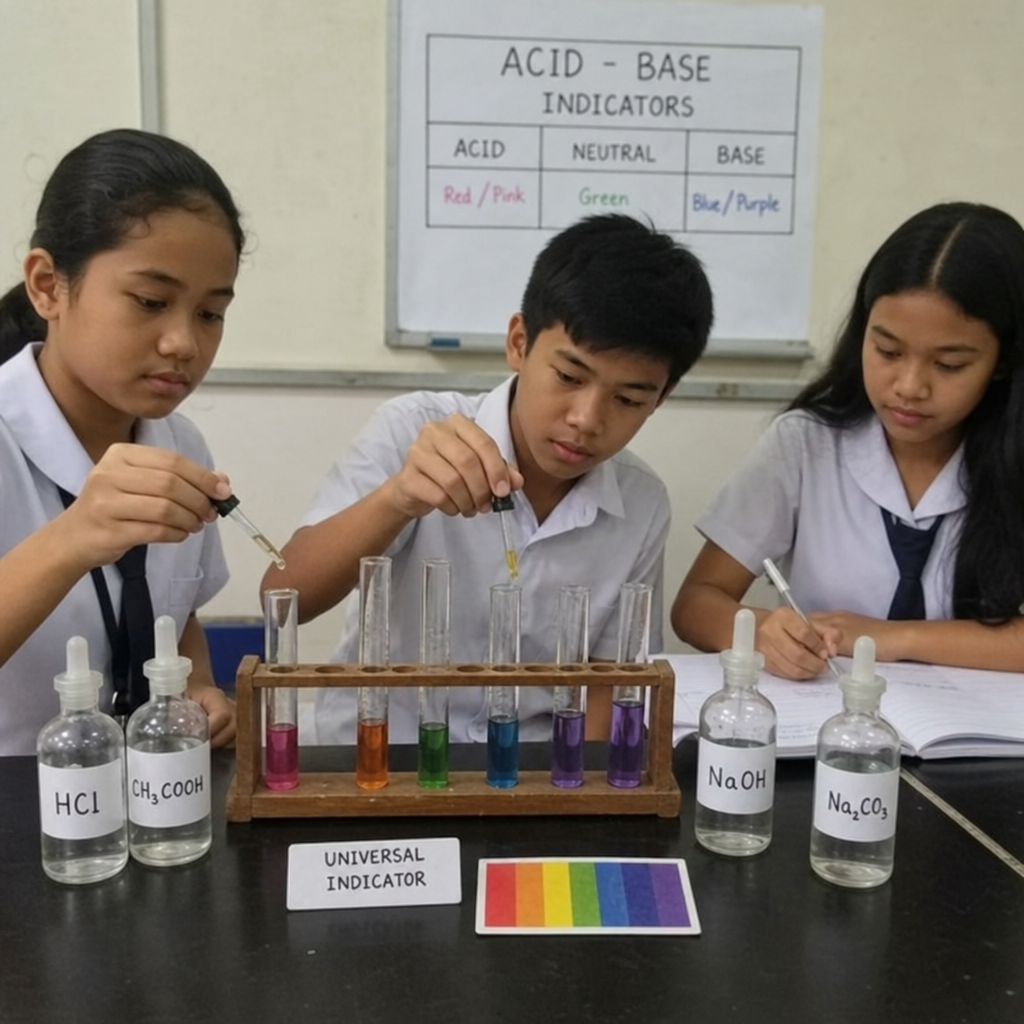
Acid-base indicators help show pH changes. Litmus, phenolphthalein, methyl orange, and universal indicator change color over set pH ranges. Indicators are especially useful in titrations, where the goal is to detect when enough acid or base has been added to complete a reaction.
Neutralization reactions connect acids, bases, and salts
A neutralization reaction happens when an acid and a base form water and a salt. A classic example is hydrochloric acid reacting with sodium hydroxide to produce water and sodium chloride. The net ionic equation often focuses on hydrogen ions and hydroxide ions forming water.
Not every neutralization mix ends at pH 7. If a strong acid reacts with a strong base in equal mole amounts, the final solution is often close to neutral. But if a weak acid or weak base is present, the salt can change the final pH because its ions may react with water.
This is a common source of confusion in an acids and bases worksheet. Students may think neutralization always means pH equals 7, but the result depends on acid strength, base strength, concentration, and amount mixed. Careful mole math comes before pH interpretation.
A simple neutralization checklist
Use this process when solving neutralization problems:
- Write the balanced equation. Name the acid, base, water, and salt.
- Classify the acid and base. Decide whether each one is strong or weak.
- Compare moles, not just concentration. Use volume and molarity to find the limiting reactant.
- Determine what remains. Extra acid, extra base, or salt hydrolysis may control pH.
- Connect to the lab result. Indicator color, endpoint, and final pH should match the chemistry.
Buffer solutions resist sudden pH change
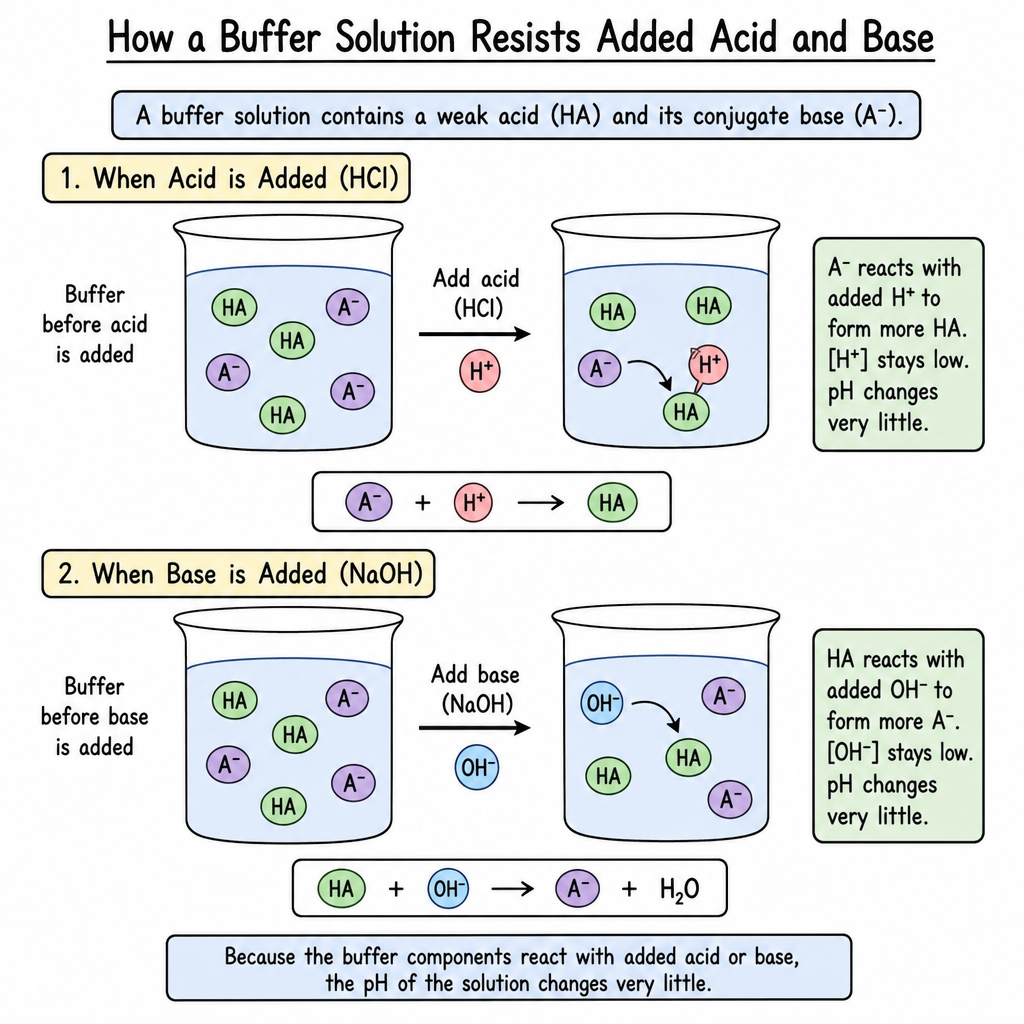
Buffer solutions are mixtures that resist large pH shifts when small amounts of acid or base are added. They usually contain a weak acid and its conjugate base, or a weak base and its conjugate acid. This pairing lets the buffer neutralize added hydrogen ions or hydroxide ions without a large shift.
Buffers matter because many systems need stable pH. Blood chemistry, fermentation, aquatic ecosystems, and lab reactions can all depend on controlled acidity. In class, buffers show how chemical equilibrium can lead to practical stability.
A buffer does not stop pH change forever. It has a limited capacity based on how much weak acid and conjugate base, or weak base and conjugate acid, is present. Once that limit is reached, pH can change fast.
How acids and bases appear in AP Chemistry
AP Chemistry acids and bases questions often ask students to combine definitions, equilibrium, stoichiometry, and pH calculations in one problem. In AP Chemistry, the chemistry of acids and bases is not just a word list; it tests whether you can connect particle behavior with math. That is why AP chem acids and bases problems often include titration curves, buffer solutions, weak acid equilibrium, and conjugate pairs.
Students studying AP chemistry acids and bases should move easily between equations, tables, graphs, and short explanations. A titration curve can show whether the analyte is a strong acid, weak acid, strong base, or weak base. The half-equivalence point can also give useful clues about a weak acid or weak base system.
For acids and bases AP Chemistry review, it helps to sort topics by skill instead of by chapter order. You need to identify species, write equilibrium expressions, calculate pH, interpret indicators, and explain how changes disturb chemical equilibrium. The strongest students do not just plug numbers into formulas; they explain why the result makes chemical sense.
Key AP-level skills to practice
Build confidence by practicing these tasks:
- Classify substances: strong acid, weak acid, strong base, weak base, amphiprotic species, conjugate acid, or conjugate base.
- Write net ionic equations: especially for neutralization and hydrolysis reactions.
- Use equilibrium expressions: including Ka, Kb, and conjugate pair links.
- Read titration curves: find equivalence points, buffer regions, and good acid-base indicators.
- Explain particle behavior: describe what happens before, during, and after a reaction.
Lab work makes the concepts visible
Acid-base labs turn abstract ideas into visible results. Students may test household substances with indicators, measure pH with probes, run titrations, or compare reactions involving acids, bases, and salts. These activities show why careful measurement, clean glassware, and accurate data recording matter.
If your course uses an experiment 6 acids bases and salts report sheet, treat it as more than a form to fill out. Use it to connect observations to chemical explanations. Color changes, gas formation, temperature changes, and pH readings should all be read in terms of ions, reactions, and equilibrium.
A strong lab conclusion does not just say that an acid or base was present. It explains the evidence, points to possible error, and links the results to acid-base theory. For example, if an indicator changed color too soon, you might check concentration errors, impurities, overshooting the endpoint, or reading the meniscus wrong.
Practical study strategies for acids and bases
Acid-base chemistry becomes easier when you study it in layers. Start with definitions and examples, then move to equations, pH, equilibrium, and applications. If you jump straight into calculations without understanding the particles involved, the math can feel disconnected.
Use an acids and bases worksheet as an active study tool. Instead of only checking the final answer, note the model used in each problem: Arrhenius, Brønsted-Lowry, equilibrium, buffer, or neutralization. This habit helps you see patterns across question types.
It also helps to keep a comparison chart. Separate strong acids from weak acids, strong bases from weak bases, and acidic salts from basic salts. Include notes on color ranges and reaction types to make your review a handy reference instead of random facts.
Final takeaway
Acids and bases are easier to understand when you connect definitions, pH, indicators, neutralization, buffers, and equilibrium in one framework. The same ideas explain simple acid base examples, lab observations, and advanced AP Chemistry questions. Focus on what particles are doing, why equilibrium shifts, and how evidence supports your conclusion, and the topic becomes far more logical than rote learning alone.
Q&A
Question: How can you tell which acid-base model to use in a problem?
Short answer: Use the model that fits the situation best. The Arrhenius model works well for simple aqueous problems where acids make hydrogen ions and bases make hydroxide ions. The Brønsted-Lowry model is better when the problem focuses on proton transfer, conjugate acid-base pairs, or substances like water that can act as either an acid or a base.
Question: Why does neutralization not always produce a solution with pH 7?
Short answer: Neutralization means an acid and base react to form water and a salt, but the final pH depends on what remains after the reaction. Equal mole amounts of a strong acid and strong base often produce a near-neutral solution. However, if a weak acid or weak base is involved, the salt’s ions may react with water and shift the pH acidic or basic.
Question: What is the difference between strong and concentrated?
Short answer: Strong describes how completely an acid or base ionizes or reacts in water. Concentrated describes how much solute is dissolved in a given volume of solution. A strong acid can be dilute, and a weak acid can be concentrated, so strong does not always mean more dangerous.
Question: Why are buffers important in acid-base chemistry?
Short answer: Buffers resist large pH changes when small amounts of acid or base are added. They usually contain a weak acid with its conjugate base, or a weak base with its conjugate acid. That makes them useful in biology, environmental chemistry, fermentation, and lab work where stable pH is needed.
Question: What should students focus on when preparing for AP Chemistry acid-base questions?
Short answer: Students should practice connecting concepts instead of memorizing separate facts. Key skills include identifying strong and weak acids and bases, recognizing conjugate pairs, writing net ionic equations, using equilibrium expressions, reading titration curves, choosing indicators, and explaining particle-level changes before, during, and after reactions.
Related Articles
Food Additives: Safety, Labels, and Storage
Food additives are used to protect food, keep it stable, add flavor or color, sweeten, and improve food during production, storage, and shipping. For consumers, they can make ingredient labels easier to read. For food businesses, they support better sourcing, food safety, and storage choices. This guide explains what food additives do, how natural additives…
Read More
What laboratory equipment does every scientist need?
Every scientist needs a reliable set of tools that makes daily work safer, cleaner, and more repeatable. From basic laboratory glassware to specialized lab instruments, the right setup helps you measure, mix, heat, observe, store, and document with confidence. This guide walks through essential laboratory equipment, practical glassware types, cleaning needs, and smart buying considerations…
Read More
Understanding the Sodium Hypochlorite Formula
Understanding the Sodium Hypochlorite Formula Sodium hypochlorite is best known as the active ingredient in many bleach products, but its chemistry is more specific than the word “bleach” suggests. The sodium hypochlorite formula, NaOCl, tells you what elements are present, how the compound behaves in water, and why it is useful for cleaning, disinfection, deodorizing,…
Read More